
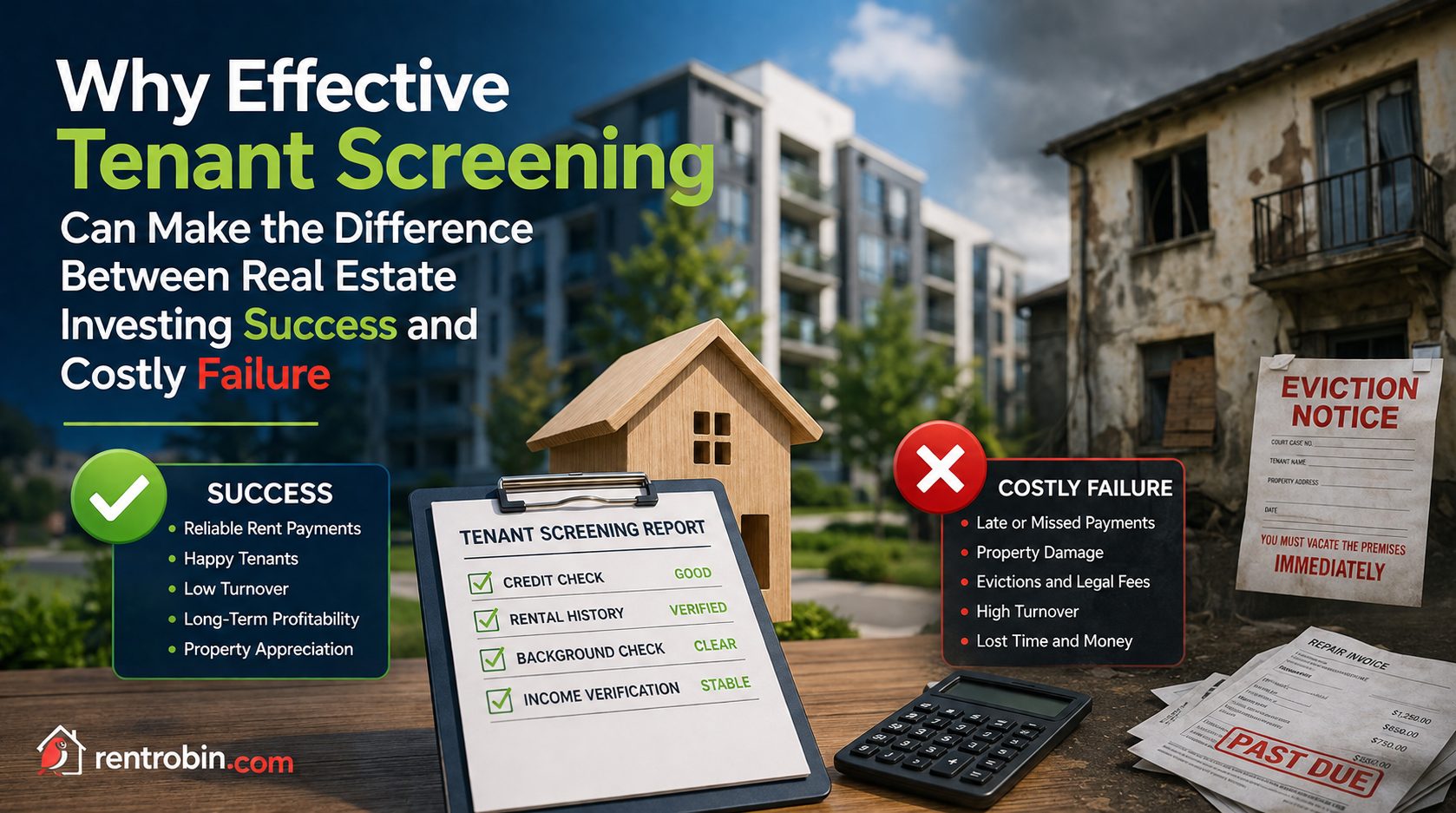
Real estate investing is often marketed as one of the best ways to build long-term wealth. Rental properties can generate monthly cash flow, appreciate over time, provide tax advantages, and create opportunities for portfolio growth. But while investors spend a great deal of time analyzing purchase prices, financing terms, rehab costs, and projected rental income, one of the most important factors in long-term success is sometimes underestimated:
who you place in the property.
At Rent Robin Property Management, we believe effective tenant screening is one of the most important safeguards a rental property owner has. A strong screening process does far more than simply fill a vacancy. It helps protect your cash flow, reduce your risk, preserve the condition of your property, minimize legal headaches, and support the long-term profitability of your investment.
The truth is simple: the wrong tenant can turn a promising investment into a costly problem very quickly. Missed rent payments, lease violations, property damage, neighbor complaints, unauthorized occupants, repeated turnover, and expensive eviction proceedings can wipe out months—or even years—of profits. On the other hand, the right resident can provide stable income, take care of the home, communicate responsibly, and contribute to a smoother, more successful ownership experience.
That is why tenant screening is not just an administrative step in the leasing process. It is a core investment protection strategy.
In this blog, we will break down why tenant screening matters so much, how poor screening can hurt your bottom line, what effective tenant screening should include, and why working with a professional Kansas City property management company can help rental owners avoid costly mistakes.
Why Tenant Screening Matters in Real Estate Investing
Every investment property owner wants the same basic outcome: consistent rent collection, low vacancy, minimal damage, and strong long-term returns. Tenant screening plays a major role in all four.
When you hand over the keys to a resident, you are not simply renting out a house or apartment. You are giving someone access to an asset that may be worth hundreds of thousands of dollars, and you are relying on them to meet a legally binding financial obligation every month. That decision should never be treated casually.
A thorough screening process helps answer some of the most important questions a rental owner can ask:
- Does this applicant have a history of paying housing-related obligations on time?
- Is their income sufficient and stable enough to support the rent?
- Have they respected lease agreements in the past?
- Are there prior evictions or serious landlord disputes?
- Are there warning signs that suggest higher financial or behavioral risk?
- Does the application information appear accurate, complete, and verifiable?
Without screening, or with a weak screening process, owners are essentially making a major business decision with incomplete information. In real estate investing, that is a dangerous way to operate.
The Financial Cost of Placing the Wrong Tenant
One of the biggest misconceptions in rental property investing is that a bad tenant only becomes a problem if they stop paying rent. In reality, the financial damage from poor tenant placement can show up in many different ways.
1. Lost rental income
The most obvious cost is missed or late rent payments. If a tenant falls behind, the owner still has a mortgage, taxes, insurance, maintenance expenses, utilities, and other holding costs to cover. Even one or two months of nonpayment can disrupt cash flow. If the situation escalates into an eviction, the lost income can multiply quickly.
2. Property damage and deferred maintenance
A poorly screened tenant may neglect the property, hide maintenance issues, violate lease terms, or cause avoidable damage. Minor issues can become major repairs when residents fail to report leaks, HVAC problems, plumbing concerns, or other maintenance needs in a timely manner. Intentional or careless damage can also significantly increase turnover costs.
3. Legal and court expenses
Evictions are expensive. Filing fees, attorney fees, court costs, lockout coordination, unpaid rent balances, cleaning, repairs, and vacancy loss all add up quickly. Even when an owner ultimately regains possession of the property, the financial damage can be substantial.
4. Increased turnover and vacancy
If a tenant is not a good fit from the beginning, the tenancy may be short-lived. High turnover means additional cleaning, repairs, marketing, showings, screening, lease preparation, and vacancy loss. Frequent turnover erodes profitability and creates unnecessary operational stress.
5. Neighborhood and reputation issues
Problem tenants can create complaints from neighbors, violate HOA rules, disturb surrounding residents, or damage the reputation of a rental property. In multifamily settings, one poor placement can create tension with other residents and increase overall management challenges.
6. Time and emotional strain
While this may not appear on a profit-and-loss statement, it matters. Chasing rent, managing conflict, responding to lease violations, dealing with court proceedings, and repairing a damaged property can be exhausting for owners—especially self-managing investors with other jobs, businesses, or family responsibilities.
When you add up lost rent, legal fees, repairs, vacancy, and time, a single bad tenant decision can cost thousands of dollars. In some cases, it can be the difference between a profitable year and a major setback.
Why “Just Filling the Vacancy” Is a Dangerous Strategy
Vacancy can be stressful for any rental owner. Every day a property sits empty is a day without rental income. Because of that, some landlords feel pressure to place a tenant quickly just to get the property occupied and the cash flow restored.
That mindset is understandable—but it can also be extremely costly.
At Rent Robin Property Management, we believe the goal is not simply to fill a vacancy as fast as possible. The goal is to place the right tenant as efficiently as possible. A rushed leasing decision can create much bigger losses than a few extra days or weeks of vacancy.
The wrong approach often sounds like this:
- “They seem nice.”
- “They really need a place quickly.”
- “They said the credit issue was a one-time thing.”
- “I don’t want to lose another week of rent.”
- “Their income is a little tight, but maybe it’ll work out.”
- “I’ll skip some verification because I need someone in there now.”
Those are emotional decisions, not investment decisions.
Successful rental property investing requires discipline. Screening criteria should be consistent, objective, legally compliant, and based on the financial and behavioral indicators most likely to predict successful tenancy. Making exceptions without careful thought can expose owners to unnecessary risk.
What Effective Tenant Screening Should Include
A strong tenant screening process is about much more than glancing at a credit score or collecting a pay stub. Effective screening should evaluate an applicant from multiple angles to help paint a more complete picture of risk, stability, and rental readiness.
While every property manager may structure the process somewhat differently, quality screening typically includes the following components.
1. A Complete Rental Application
Everything starts with a thorough application. An incomplete or vague application is a red flag in itself.
A strong application should collect key information such as:
- full legal name and identifying information
- current and prior addresses
- rental history and landlord references
- employment and income information
- other sources of income, if applicable
- occupancy information and proposed household members
- pet information, if relevant
- authorization for background and credit screening
The application provides the foundation for verification. If information is inconsistent, missing, or clearly inaccurate, that deserves closer attention.
2. Income and Employment Verification
One of the most important screening questions is whether the applicant can realistically afford the rent.
A good screening process does not simply accept a stated income at face value. It verifies income through appropriate documentation and, when necessary, employment confirmation. This may include pay stubs, employer verification, offer letters, bank statements, or other supporting records depending on the applicant’s situation.
Stable and sufficient income matters because even a well-intentioned resident can struggle if the rent places too much strain on their budget. Screening should evaluate not just whether an applicant wants the home, but whether they have the financial ability to sustain the lease.
3. Credit Review
Credit reports are not the only factor in screening, but they can provide valuable insight into financial patterns and obligations.
A credit review may help identify:
- payment history trends
- collection accounts
- charge-offs or serious delinquencies
- debt burden and financial stress indicators
- prior housing-related collections or judgments
- patterns that may suggest elevated risk
It is important to remember that credit should not be viewed in isolation. A credit report is one piece of the picture, not the entire picture. However, ignoring it altogether can mean missing important warning signs.
4. Rental History Verification
Past rental behavior often provides one of the best indicators of future rental behavior.
A strong tenant screening process should verify prior rental history when possible, including:
- payment consistency
- lease compliance
- property condition at move-out
- notice and communication history
- complaints, disturbances, or lease violations
- whether the tenant would be rented to again
Previous landlords may be able to provide insight into whether an applicant was responsible, communicative, and respectful of the lease. While references should always be evaluated carefully, rental history can reveal patterns that are highly relevant to future tenancy.
5. Background Screening
Background screening policies must always be handled carefully, consistently, and in compliance with applicable laws and fair housing requirements. That said, screening for certain issues may still be an important part of evaluating overall risk depending on the property, the circumstances, and the screening criteria being applied.
This is one of the many areas where working with a professional property manager is valuable. Tenant screening must be both thorough and legally compliant. Screening practices that are inconsistent, overly casual, or poorly documented can create liability for landlords.
6. Identity and Information Verification
Fraud has become an increasingly important issue in rental housing. Fake pay stubs, falsified documents, identity inconsistencies, and misleading application information are all risks landlords need to take seriously.
That is why screening should include a close review of the information provided and a willingness to verify suspicious or inconsistent details. A polished application does not necessarily mean an honest application.
At Rent Robin, we believe convenience should never replace caution. If something does not add up, it deserves a closer look.
The Difference Between Screening and Guessing
Some landlords rely heavily on instinct when selecting tenants. They meet an applicant, have a pleasant conversation, and decide based on whether the person “seems trustworthy.” While professionalism, communication, and demeanor can certainly matter, instinct is not a substitute for screening.
Tenant placement should not be based on who tells the best story, who is the most persuasive in a showing, or who seems the most desperate to move in. It should be based on objective criteria, verified information, and a consistent process.
That distinction matters because people can present themselves well while still being financially unstable, chronically late, evasive, or careless with property. Conversely, an applicant who is quiet or less polished in conversation may actually be a strong and responsible tenant.
Good screening removes as much guesswork as possible from the process.
Fair Housing and Consistency Matter
One of the most important aspects of tenant screening is consistency.
Rental owners must be careful to apply screening criteria in a fair, objective, and legally compliant manner. Inconsistent screening, subjective decision-making, or informal “gut feeling” approvals can create serious fair housing concerns and legal exposure.
That is why screening policies should be clearly defined and consistently applied. Property owners should know in advance what standards they use, what documentation they require, and how applications are evaluated. This protects both the owner and the applicant by making the process more transparent and defensible.
Professional property management can be especially valuable here because fair housing compliance is not optional. Screening needs to be both effective and legally sound.
How Effective Tenant Screening Supports Long-Term ROI
Real estate investing is a long game. The most successful investors do not just focus on the next month’s rent—they focus on the long-term performance of the asset.
Effective tenant screening supports long-term ROI in several ways.
It protects cash flow.
Reliable rent payments are the foundation of rental property performance. Screening helps reduce the likelihood of missed payments and financial instability.
It reduces turnover costs.
A strong resident who stays longer, pays on time, and respects the lease is far more profitable than a revolving door of poorly screened tenants.
It helps preserve property condition.
Residents who communicate responsibly, report maintenance issues, and care for the home help protect the physical asset over time.
It lowers legal risk.
A better screening process reduces the likelihood of serious lease violations, disputes, and evictions.
It creates a more stable ownership experience.
Good tenant placement means fewer emergencies, fewer unpleasant surprises, and a more predictable investment.
In other words, screening is not just about avoiding bad outcomes. It is about creating better ones.
Why Kansas City Rental Property Owners Should Take Screening Seriously
Kansas City continues to be an attractive market for many real estate investors because of its relative affordability, rental demand, and investment potential. But like any market, profitability depends on good decisions—not just at the time of purchase, but throughout the life of the property.
Tenant placement is one of those decisions.
Whether you own a single-family rental in Kansas City, a small multifamily property, or a growing local portfolio, your resident selection process can have a direct impact on your income, your expenses, your stress level, and your long-term returns. Screening should never be treated as a quick formality or a box to check.
It is one of the most important risk-management tools available to a rental property owner.
Why Many Investors Choose Professional Property Management for Tenant Screening
For self-managing landlords, tenant screening can be one of the most difficult parts of owning rental property. It requires time, consistency, documentation, legal awareness, and the ability to evaluate applicants without becoming emotional, rushed, or overly flexible.
That is one of the reasons many investors choose to work with a professional property management company.
At Rent Robin Property Management, we understand that placing the wrong tenant can be incredibly expensive. We also understand that good residents are one of the most valuable assets a rental owner can have. Our goal is not simply to get a property leased—it is to help protect our clients’ investments by placing qualified residents through a thoughtful, professional, and consistent screening process.
We believe effective property management means looking beyond short-term convenience and focusing on long-term results. That includes helping owners reduce risk, protect cash flow, preserve property condition, and maximize profitability while safeguarding the long-term value of the asset.
Final Thoughts: Screening Is an Investment Protection Tool, Not Just a Leasing Step
Every real estate investor wants to maximize returns and minimize unnecessary risk. Effective tenant screening is one of the clearest ways to do both.
The right tenant can make rental ownership smoother, more profitable, and more predictable. The wrong tenant can create missed rent, expensive repairs, legal trouble, repeated vacancy, and months of stress. That is why tenant screening is not just a leasing task—it is an investment protection tool.
At Rent Robin Property Management, we believe successful real estate investing is about more than collecting rent. It is about making smart decisions that protect your property, your cash flow, and your long-term financial goals. Screening is one of those decisions.
If you own rental property in the Kansas City area and want help placing qualified residents, reducing leasing risk, and protecting your investment, Rent Robin is here to help. A strong screening process cannot eliminate every challenge in rental housing, but it can dramatically improve your odds of success—and in real estate investing, that can make all the difference between long-term profitability and costly failure.